When people hear “product design”, most think of appearance: a nice colour, a pattern, beautiful lettering.
Appearance is the last step. Product design is the chain of decisions before it: Who will use this piece? Where? What problem does it solve? And what are we willing to give up for it?
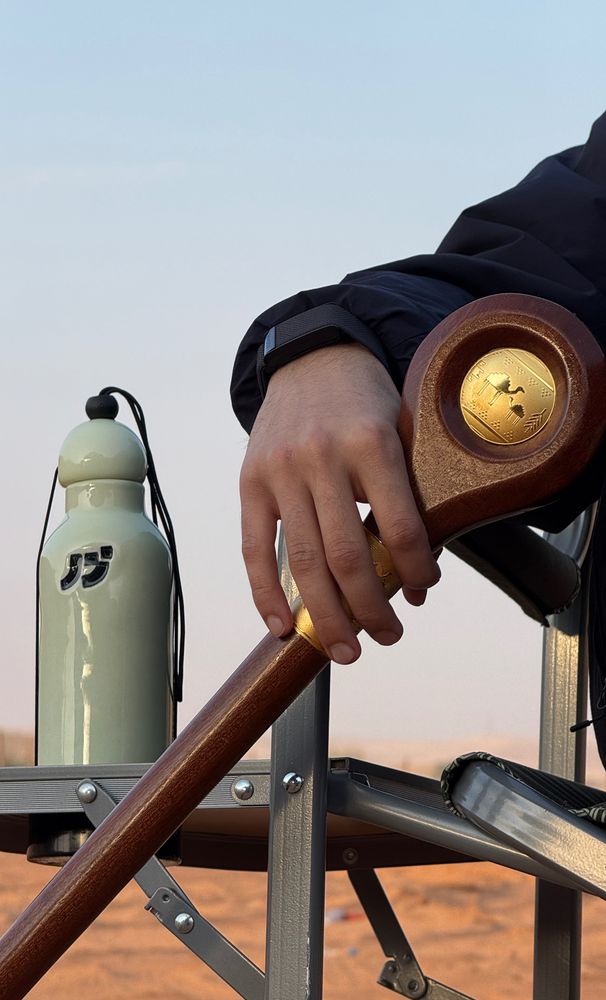
The easiest way to explain it is with real examples. Thrr (ذر) is a Saudi design brand founded in Riyadh in 2015 that designs and makes everyday objects and gifts inspired by Saudi culture. Here are four Thrr pieces, and the decision behind each one.
The Thrr Gharsha: one decision that changed everything
The problem: water in plastic bottles changes taste over time, and metal gives it another taste.
The decision: the layer that touches the water is natural clay.
The trade-off: if we left the clay exposed on the outside, it would cool the water by evaporation — but it would sweat and wet your bag and car. So we glazed the outside. The result: a dry bottle you carry in one hand, in exchange for not cooling.
That's product design: every decision has a price, and the designer chooses which price is worth paying. See the Gharsha.
Jackaroo Thrr: two games in one box
The problem: every gathering has people who want a long game and people who want something quick, and nobody wants to carry two boxes.
The decision: a Jackaroo board with 108 holes on the lid, and a quick flick-puck game inside the same box.
The material: solid natural wood, and a hardcover box built to be carried from one gathering to the next.
Antidotes mugs: the packaging is part of the idea
Sometimes the design isn't in the shape of the object itself. Each Antidotes (Mudadat) mug has its own name — “Antidote to Riyadh Traffic”, “Antidote to Overthinking”, “Antidote to Being Too Nice” — and comes in packaging that looks like a medicine box.
The decision here was to put the whole identity into the name and the packaging. That's why it became the easiest small gift to make someone laugh — and everyone finds the antidote that suits them.
The Najdi Door box: packaging that doesn't get thrown away
The problem: most gift boxes end up in the bin on the day of the occasion.
The decision: make the box itself an object — wood carved with the traditional Najdi door pattern. It arrives empty, you arrange your gift in it, and afterwards it stays on a shelf as a case for watches and papers. See the box.
How the design process works at Thrr
- The question: what's the problem, and for whom exactly?
- Research: what's already on the market, and why isn't it enough?
- Sketching: lots of ideas on paper; we throw most of them away.
- Prototype: a first piece you can hold in your hand.
- Testing: we use it for days. Where does it annoy? Where does it break?
- Refinement, then manufacturing: before each stage we write down what would make us stop — so we don't keep going with an idea that doesn't work just because we've put effort into it.
Why does this matter to you?
Because the difference between a designed piece and a “decorated” one shows after a month of use, not in the photo. A designed piece knows what it does — and tells you honestly what it doesn't.
Product design for your organisation
Thrr works the same way with companies and government entities: a corporate gift, a trophy, or a product carrying the organisation's identity. We start from “What do you want the recipient to feel?”, not “What colour is the logo?”. Contact us about corporate projects.